Geography Class 20
Questions on topics taught in the previous class (05:12 PM)
Climatology (05:21 PM)
- Atmosphere: The gaseous envelope which surrounds the earth from all sides and is attached to the earth's surface by gravitational force.
- Weather: It is the day-to-day state of the atmosphere.
- Climate: The average atmospheric conditions of an area over a considerable period of time calculated for a minimum of 30 years.
Composition of Atmosphere (05:45 PM)
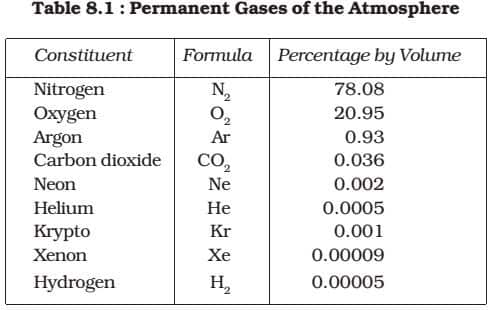
- Nitrogen: The atmospheric nitrogen gets converted into soil nitrogen through nitrogen fixation.
- Plants are capable of absorbing it from the soil.
- Oxygen: Oxygen is chemically active. Oxygen is taken directly through respiration.
- It is consumed at the cellular level.
- Oxygen is released into the atmosphere through the process of photosynthesis by plants.
- Carbon dioxide: It is released by both plants and animals and consumed by plants only i.e. during Photosynthesis.
- It is called Greenhouse Gas.
- It helps in maintaining a stable temperature in the atmosphere.
- Noble Gases: These gases are non-reactive in nature.
- Water vapour: It is the most variable gas in the atmosphere. It is responsible for all weather phenomena in the atmosphere.
- It is a greenhouse gas capable of absorbing Heat.
- 99 per cent of water vapour is concentrated in the lower 16 km of the atmosphere.
- Dust Particles: It is concentrated in the lower levels of the atmosphere.
- It acts as hygroscopic nuclei and helps in condensation and cloud formation.
- It is released into the atmosphere through weathering, erosion, and from Volcanic Eruptions.
| Hygroscopic Nuclei: Hygroscopic means something which attracts water. Hygroscopic Nuclei are microscopic particles that allow water vapours to condense on their surfaces. |
Structure of Atmosphere (06:20 PM)
| Homosphere | Heterosphere |
| It is a layer with uniform mixing of gases. | In this layer, gases form different layers. |
| It is up to 80 km. | It is beyond 80 km. |
| It contains water vapour and dust particles. | It contains the minimum amount of water vapour and dust particles. |
| In this layer, gases are in molecular form. | In this layer, gases are in atomic form. |
| It consists of three layers: troposphere; Mesosphere and Stratosphere. | It consists of two layers: Thermosphere and Ionosphere. |
Troposphere (06:47 PM)
- It extends from sea level to 16 kilometres in the tropics and 6 kilometres in the poles.
- It is a zone of turbulence and convection due to the continuous mixing of gases.
- All weather phenomenon is restricted to Troposphere due to the presence of water vapour and dust particles.
- Temperature decreases from sea level at 6.5 degrees Celsius per kilometre, called the Normal Lapse Rate.
- The edge of the troposphere is called the tropopause, which is a transition zone to the stratosphere.
Stratosphere (07:14 PM)
- It extends from Tropopause to 50 Kilometres.
- It is called so because the layers are stratified and non-convective in nature.
- The temperature rises in the stratosphere due to the absorption of UV rays by Ozone in this layer.
- The conditions are extremely dry except for some rare clouds called stratospheric clouds. Example: Mother of Pearl.
- The top of the stratosphere is called Stratopause.
Mesosphere
- It extends from stratopause to 80 km.
- Temperature decreases with height and reaches its lowest in the atmosphere.
- The top of the mesosphere is called Mesopause.
Thermosphere (07:43 PM)
- It extends from 80 km to 500-700 km.
- It consists of a lower Nitrogen layer and upper oxygen layer.
- The temperature rises rapidly due to the absorption of high-energy solar radiation.
- Temperature reaching up to 1200 degree celsius at 350 km.
Exosphere
- It extends from the edge of the thermosphere to the vacuum.
- It contains atomic Oxygen, Helium, and Hydrogen.
- It contains a magnetosphere composed of electrons and Protons derived from Solar Winds and charged particles.
- They have been arranged in two bands at 3000 km and 16000 km which are called as Van-Allen Radiation Belts.
Ionosphere
- It exists between 80 to 650 km within the thermosphere.
- It is formed due to ionization by solar radiation. It is made up of multiple layers D, E, F, G, etc
- Ionosphere reflects short-wave radio waves helping in radio communication.
Karman Line
- It is the boundary where outer space begins. It is at an altitude of 100 km from sea level.
- International law does not define the limit of air space. It is a line agreed upon for aircraft navigation through consensus.
- Above, this line of air is too thin for any aircraft balloon or any other flight, other than spacecraft.
(Next Class: Insolation, Heat Budget)